You just got your SAT score back. The number looks solid… but then your eyes land on something else:
Percentile: 82nd.
Is that good? Is that average? Is that Ivy-level brilliance or “meh”?
If SAT scores feel confusing, you’re not alone. Most students look at their number and still have no idea how competitive they are. That’s where SAT percentiles come in and understanding them can completely change how you plan your next move.
Let’s break it down, in a way that makes sense.
Raw Score vs. Scaled Score vs. SAT Percentiles (Yes, They’re Different)
Before we talk strategy, we need to clear up one big misconception: your SAT score is not your SAT percentile.
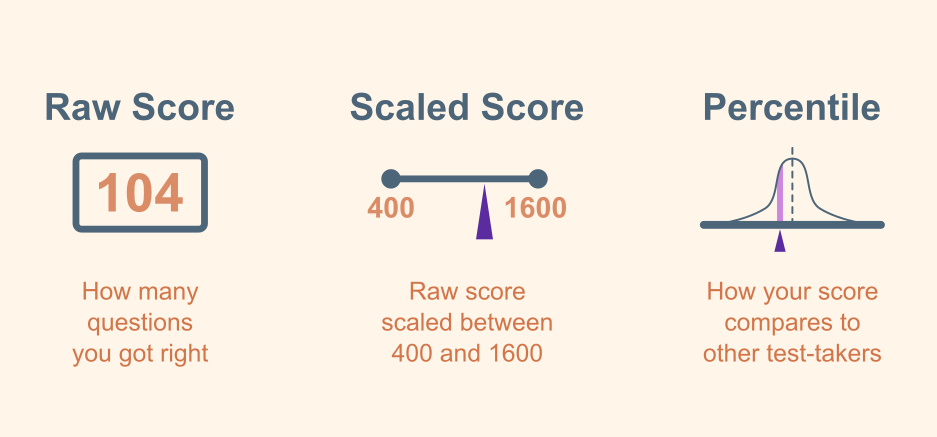
Raw Score
This is the simplest one – it’s just:
- How many questions you got right
- No penalty for wrong answers
You never see this number directly, but it’s the starting point.
Scaled Score
Your raw score is then converted into a scaled score between 400 and 1600. This adjustment accounts for slight differences in difficulty between test dates. This is the number colleges usually ask for.
SAT Percentiles
Now here’s the powerful part. SAT percentiles show how your score compares to other test-takers. For example:
- 50th percentile = you scored better than half of students
- 75th percentile = you scored better than 75% of students
- 90th percentile = top 10%
According to the College Board, percentiles are based on the performance of recent SAT test-takers, not everyone in the world. Percentiles turn your score into context.
Why SAT Percentiles Matter More Than You Think?
Colleges don’t just look at your SAT score in isolation. They look at where you stand relative to other applicants. Many colleges publish:
- 25th percentile scores (lower range of admitted students)
- 50th percentile (median) scores
- 75th percentile scores (upper competitive range)
If your score is:
- Below the 25th percentile → admission is a reach
- Around the 50th percentile → you’re competitive
- Near or above the 75th percentile → strong position
This is why SAT percentiles directly affect admissions strategy.
EH Tutoring often reminds students: A “good” SAT score means nothing without understanding who you’re being compared to.
Using SAT Percentiles to Set Realistic (and Smart) Score Goals
Instead of asking, “Is 1400 a good score?” Ask: “What percentile do I need for my target colleges?”
Here’s a smarter way to set goals:
- List your target schools
- Look up their middle 50% SAT score range
- Identify the 75th percentile score
- Make that your long-term goal
Why the 75th percentile? Because reaching it:
- Makes your application more competitive
- Provides a buffer if other areas are average
- Reflects real improvement, not just luck
College Board and admissions data confirm that percentiles offer a clearer benchmark than raw scores alone.
Percentiles Are Not Labels; They’re Direction Markers
Here’s something students rarely hear: SAT percentiles are not fixed identities.
An 1100 at the 61st percentile today does not define where you’ll end up. What matters is how you use that information.
At EH Tutoring, we help students:
- Identify why their percentile is where it is
- Target weak sections strategically
- Build score improvements that shift percentiles, not just points
A 100-point jump can move you across thousands of students nationwide.
Final Takeaway: Know the Game You’re Playing
SAT percentiles translate your effort into meaning. They help you:
- Understand competitiveness
- Set realistic goals
- Choose smart retake strategies
- Apply with confidence
The SAT isn’t just a number, it’s a comparison. When you understand your percentile, you stop guessing and start planning. And that shift? That’s where real progress begins.