
Raise your hand if this sounds familiar:
You start the SAT Reading section feeling confident…
10 minutes in, your pulse picks up…
Halfway through, you’re skimming like it’s a sprint…
And then – boom – the clock wins again.
If SAT time management feels like your biggest enemy, you are far from alone. The SAT Reading section is intentionally tight – it’s designed to test your pacing, processing, and decision-making under pressure.
But here’s the good news:
Time isn’t the problem. Strategy is.
Let’s fix that.
Understand the Section Structure – and the Pressure
If you don’t fully understand what you’re up against, no strategy will save you.
The digital SAT Reading section includes short passages paired with questions, drawn from literature, history, science, and social science.
According to College Board, students get 64 minutes for the Reading & Writing section – split into two modules, each with around 32 minutes and 25 questions.
That means roughly 1 minute and 15 seconds per question. No wonder students feel the clock breathing down their necks.
The key: you don’t have time to read every word slowly.
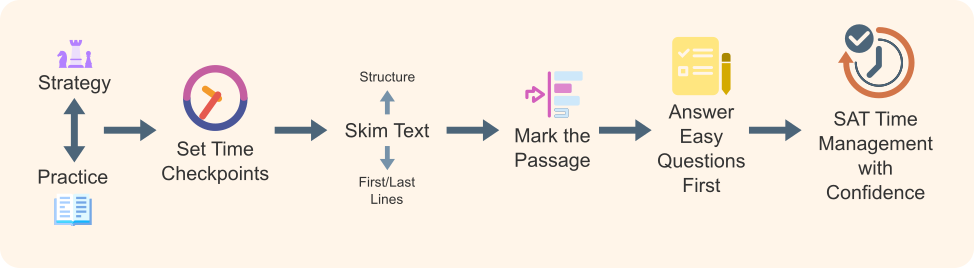
Skim for Strategy, Not Perfection
Good SAT readers aren’t fast – they’re selective. Stop trying to digest the whole passage like it’s your English class essay.
Instead:
- Read the intro for context
- Focus on first/last lines of paragraphs
- Notice tone, structure, and argument shifts
- Skim details – don’t camp there
Think of it as getting the map before you explore the roads.
Answer the Easy Questions First
Not all questions are created equal. On SAT Reading, line-reference and vocabulary-in-context questions are your best friends.
Do first:
- Line-find questions
- Vocabulary meaning questions
- Direct detail questions
Save for later:
- Inference questions
- Author’s purpose/tone
- Big-picture themes
Why? Because when time runs tight, you want to be stuck on fewer hard questions, not the easy points.
Mark the Passage Like It Owes You Money
Active reading = faster answering.
Mark:
- Names & dates
- Major claims & shifts
- Contrast words (however, although, on the other hand)
Your notes shouldn’t look like a coloring book – just enough for fast backtracking.
Set Time Checkpoints
Here’s your pacing cheat code:
| Checkpoint | Time Goal |
| After Passage 1 | 12-13 minutes |
| After Passage 2 | 24-26 minutes |
| Final Passage | Use remaining time/check answers |
Running behind? Guess smart and move on!
Lingering = lost points.
Practice Like It’s Game Day
The biggest SAT time-management mistake? Only practicing casually.
Do this instead:
- Set a timer
- Practice in silence
- Avoid pausing
- Review why you slowed down
Top scorers don’t just practice questions – they practice pacing discipline.
Bonus: Confidence Comes from Prepared Strategy
If you keep rushing or freezing, it isn’t a “reading problem” – it’s a system problem. When students at EH Tutoring learn structured timing and reading techniques, they don’t just score higher, they breathe easier.
And guess what? We love helping students beat the clock.
Final Thought
The SAT isn’t testing perfection – it’s testing control. Master pacing, and suddenly the test doesn’t feel scary. It feels manageable. You don’t need more minutes. You need more strategy per minute. Ready to practice smarter, not harder? Let’s work together to turn panic into confidence.
Book a complimentary SAT strategy call with EH Tutoring and stop letting the clock win.